 Ring Studio
Blue Sapphire Engagement Rings
Blue sapphire engagement rings pair a hardness of 9 on the Mohs scale with the richest blue in the gem world, which makes them one of the few coloured stones genuinely suited to everyday wear. This guide covers how to judge the colour, what treatments mean, and which settings flatter a blue centre stone.
On this page
- Why blue sapphire works as an engagement ring stone
- How to judge blue sapphire colour
- Heat treatment, diffusion and what to ask
- Origins and what they really tell you
- How much does a blue sapphire engagement ring cost?
- Best cuts, settings and metals for a blue sapphire
- Design a blue sapphire ring in Ring Studio
- Caring for a blue sapphire ring
- Mineral
- Corundum (aluminium oxide), coloured blue by iron and titanium
- Hardness
- 9 on the Mohs scale
- Common treatment
- Heating; less often beryllium diffusion or surface diffusion
- Key origins
- Sri Lanka, Madagascar, Myanmar, Thailand, Australia, Montana (USA); historically Kashmir
- Best settings
- Prongs or bezel in white metal or yellow gold; halos boost perceived size
Why blue sapphire works as an engagement ring stone
Most coloured gems ask for some compromise when worn every day. Blue sapphire mostly doesn't. Corundum scores 9 on the Mohs scale, so it resists the scratches that dull softer stones, and it has no tendency to split along a cleavage plane the way a diamond or topaz can when struck at the wrong angle. Its toughness is rated good to excellent, which is why sapphires survive in antique rings that have been worn for a century.
The other reason is history and symbolism. Sapphire was a favourite centre stone for royal and aristocratic rings long before the modern diamond solitaire took over, and a blue centre still reads as deliberate and personal rather than conventional. If you are weighing it directly against a diamond, our sapphire vs diamond comparison goes through sparkle, price and wear side by side. For sapphires of every colour, see the broader sapphire engagement ring guide.
How to judge blue sapphire colour
Colour drives most of a sapphire's value, far more than clarity or carat. Gemmologists break it into three parts:
- Hue: the actual colour. Pure blue and slightly violetish blue are most sought after; greenish blue usually sells for less.
- Tone: how light or dark it is. Medium to medium-dark is the sweet spot. Very dark stones can look almost black in dim light, which is common in some Australian and Thai material.
- Saturation: the intensity. Vivid, strong colour commands the highest prices; greyish or brownish tints lower value.
Look at any stone you're considering in daylight, warm indoor light and LED light. Some sapphires shift noticeably, looking more violet under incandescent bulbs or greyer in shade. Ask for videos in several lighting conditions if you're buying online.
| Colour description | What it looks like | Typical market position |
|---|---|---|
| Vivid medium blue | Bright, saturated, holds colour in most light | Top of the range |
| Cornflower / velvety blue | Soft, slightly hazy saturation (fine silk) | Premium, especially with origin report |
| Royal blue | Deep, rich, slightly violet | High, if not overly dark |
| Light or pastel blue | Pale, airy, often very bright | Affordable; popular for larger sizes |
| Inky or very dark blue | Looks near-black away from light | Lower |
| Greenish or teal blue | Blue with visible green | Variable; teal sapphire has its own fans |
Heat treatment, diffusion and what to ask
Heating is the norm. Most blue sapphires sold today have been heated to improve colour or dissolve rutile silk, and the result is permanent under normal wear. The trade accepts it, but it must be disclosed, and a stone with a lab report stating "no indications of heating" is worth noticeably more.
Other treatments matter more:
- Lattice (beryllium) diffusion: the stone is heated with beryllium so colour penetrates deeply. Common on orange and yellow sapphire, also used on some blues. It should be disclosed and sells for much less.
- Surface diffusion: colour sits in a thin layer near the surface. If the stone is ever repolished or recut, the colour can be lost. Avoid it for an engagement ring.
- Fracture filling: rarer in sapphire than in ruby, but it happens. Filled stones are less durable around jewellery repairs.
For any stone over about half a carat or a significant budget, ask for a report from an independent gem laboratory that covers species, natural or lab-grown, and treatment. Origin reports are optional and cost extra; they matter mostly at the high end.
Origins and what they really tell you
Origin names carry weight in the sapphire trade. Kashmir stones from the late 19th and early 20th centuries are legendary and rarely seen. Myanmar (Burma) is known for rich royal blues, Sri Lanka (Ceylon) for brighter, lighter blues, and Madagascar has become a major source of fine material in recent decades. Australia, Thailand and Cambodia produce darker stones, and Montana in the US produces paler, often steely blues.
Treat origin as a story, not a quality guarantee. A beautiful Madagascan stone can outshine a mediocre Sri Lankan one. If ethical sourcing matters to you, ask the seller about the supply chain; small-scale mining is common in coloured stones and traceability varies widely.
How much does a blue sapphire engagement ring cost?
Prices span an enormous range because colour, treatment and origin move the needle so much. As rough estimates in British pounds for the loose centre stone (excluding the ring), as of late 2026:
| Stone (around 1 carat) | Rough loose-stone range (GBP) |
|---|---|
| Lab-grown blue sapphire | Tens of pounds to a few hundred |
| Natural, heated, commercial colour | Roughly £300 to £1,500 |
| Natural, heated, fine vivid colour | Roughly £1,500 to £5,000+ |
| Natural, unheated, fine colour with report | Often several thousand pounds per carat and up |
These are broad estimates that vary a lot by retailer, quality and market. Prices per carat climb steeply above 2 to 3 carats for fine colour. Compared with a diamond of the same size, a good heated sapphire is usually far cheaper, which is why many people choose a larger sapphire or add a halo. Our engagement ring cost guide covers the setting and metal side of the budget.
Best cuts, settings and metals for a blue sapphire
Sapphires are usually cut to keep weight and colour rather than to maximise sparkle, so they come in many shapes, with ovals and cushions most common. An oval lengthens the finger and hides colour zoning well; a cushion feels classic and slightly vintage. Emerald cuts show colour beautifully but reveal inclusions, so pick a clean stone.
- Halo: a ring of white diamonds around a blue centre is the look many people picture first. It increases contrast and makes a 1 carat stone read much larger. See halo engagement rings.
- Three stone: a sapphire flanked by diamonds, or a diamond flanked by sapphires, is a long-standing combination.
- Bezel: protects the girdle and gives a clean, modern outline.
- Metal: platinum or white gold keeps the blue crisp and cool; yellow gold warms it and suits vintage designs. Avoid placing a very dark sapphire in thick yellow gold, which can make it look darker still.
Design a blue sapphire ring in Ring Studio
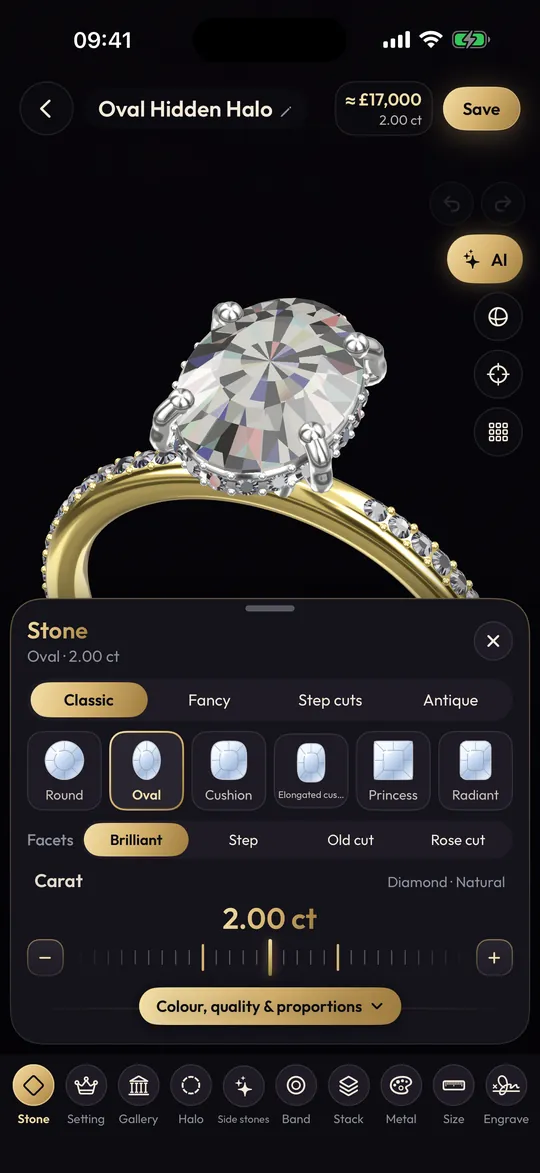
Ring Studio lets you see a blue sapphire centre stone in real-time 3D before you speak to a jeweller. Here's a simple route:
- Open the 3D designer and choose blue sapphire as the stone type.
- Pick a shape. Oval, cushion, emerald and pear are all free; elongated cushion, radiant and the more unusual shapes are part of Pro.
- Adjust the carat size and try north-south or east-west orientation.
- Add a classic or hidden halo, or choose three stone side stones to bring white diamonds into the design.
- Switch between platinum, white gold and yellow gold to see how the metal changes the blue.
- Check the live price estimate as you go. It's for comparison, not a quote.
You can also describe the ring in words, such as "oval blue sapphire with a diamond halo on a thin platinum pavé band", and the AI builds it in 3D for you to refine by chatting. When you're happy, share the ring code with your jeweller. The app is a design and visualisation tool: it doesn't sell stones or make rings, and it doesn't offer karat options, so confirm 14k or 18k with your jeweller.
Caring for a blue sapphire ring
Warm water, a drop of mild washing-up liquid and a soft toothbrush are all a heated sapphire needs. Ultrasonic cleaners are generally safe for untreated or heat-only stones, but avoid them for fracture-filled or diffused stones, and check the prongs every year or so. Sapphire won't scratch easily, yet a hard knock can still chip an exposed corner, so pointed shapes benefit from V-prongs or a bezel. Our engagement ring care guide covers cleaning in more detail.
Verdict
A blue sapphire is one of the most practical and characterful alternatives to a diamond. Prioritise colour over clarity, insist on treatment disclosure, and use a white metal or halo if you want the blue to stand out. Prefer something softer in tone? Compare it with a pink sapphire.
Frequently asked questions
Are blue sapphires good for engagement rings?
Yes. Sapphire is 9 on the Mohs scale, second only to diamond among popular gems, and it has no easy cleavage, so it copes well with daily wear when set securely.
Are most blue sapphires heat treated?
Most blue sapphires on the market have been heated to improve colour and clarity. Heating is a long-established, stable treatment, but unheated stones with a report confirming no heat sell at a clear premium.
What is the most valuable blue sapphire colour?
A medium to medium-dark, vivid, slightly violetish to pure blue that stays saturated under different lighting is usually most prized. Stones that look inky or very pale are typically valued lower.
What does cornflower blue mean?
Cornflower blue is a trade term for a medium, velvety, softly saturated blue often associated with Kashmir and fine Sri Lankan stones. It is a description, not a formal grade, so ask what a seller means by it.
Do lab-grown blue sapphires exist?
Yes. Lab-grown sapphire has the same chemistry and hardness as natural sapphire and costs a fraction of the price. Reputable sellers disclose it, and a gem lab can tell the difference.
Keep reading
 Oval Engagement Rings: How to Choose a Beautiful OneOval engagement ring guide: the best length-to-width ratio, judging the bow-tie, carat-to-mm sizes, flattering settings …