 Ring Studio
Wedding Band Styles: Every Type Explained
The main wedding band styles are plain metal, pavé, eternity, knife edge, twisted, engraved or vintage, and contour bands shaped to fit an engagement ring. The right one depends on how it sits beside your engagement ring, how much sparkle you want and how hard you are on your hands.
On this page
- The main wedding band styles at a glance
- Plain metal bands
- Pavé and eternity bands
- Knife edge, twisted and textured bands
- Contour bands: curved and chevron
- Will a straight band sit flush with my engagement ring?
- How wide should a wedding band be?
- Designing a wedding band in Ring Studio
- How to choose between wedding band styles
- Main styles
- Plain, pavé, eternity, knife edge, twisted, bypass, engraved, contour
- Contours
- Straight, curved, chevron (V)
- Typical widths
- Roughly 1.5-3 mm (often women's), 4-6 mm (often men's)
- Biggest pitfall
- A straight band that will not sit flush with a low or haloed engagement ring
- In Ring Studio
- Design a band alone or stack it above or below your engagement ring
The main wedding band styles at a glance
| Style | What it is | Best for | Watch out for |
|---|---|---|---|
| Plain | Polished, unset metal | Everyday durability, any engagement ring | Shows scratches on high polish |
| Pavé | Small diamonds set close across the top | Sparkle beside a solitaire | Tiny stones can loosen over the years |
| Half eternity | Stones across the top half | Sparkle that can still be resized | Stones may rotate to the side if loose-fitting |
| Full eternity | Stones all the way round | Maximum sparkle | Hard or impossible to resize |
| Knife edge | Band rises to a ridge along the top | Looking finer than its width | The ridge can wear with time |
| Twisted | Two strands twisted together | Texture, romance | More crevices to clean |
| Bypass and asymmetric | Ends that pass or offset | Fashion-led stacks | Can be awkward to pair |
| Engraved / vintage | Patterned or milgrain detail | Vintage and Art Deco rings | Patterns soften with wear |
| Contour (curved, chevron) | Shaped to follow the engagement ring | Flush fit with low or haloed settings | Worn mostly with its partner ring |
Plain metal bands
The simplest wedding band is also the most hard-wearing. A plain band in the same metal as the engagement ring makes the pair look like a set and never competes with the centre stone. Within plain bands, the main choices are profile (flat, domed, court) and finish (polished, satin or brushed). For thicker bands typically worn by men, see men's wedding band styles.
Pavé and eternity bands
A pavé band sets small diamonds closely across the top, held by tiny beads or prongs. It adds sparkle right where the eye lands. An eternity band is the same idea taken further, with stones running halfway or all the way round. Full eternity bands look spectacular but cannot easily be resized, so get your size right; our ring sizing guide helps. For more on the style, read eternity rings and pavé vs plain band.
Knife edge, twisted and textured bands
A knife edge band rises to a ridge, catching a line of light and looking finer from above than its actual width. A twisted band winds two strands together for a rope-like texture, and works beautifully beside a twisted engagement ring or as a contrast to a plain one. Engraved and vintage bands carry patterns or milgrain edges that match antique-style engagement rings.
Contour bands: curved and chevron
Contour bands are the answer to one of the most common wedding ring problems: a straight band that will not sit against the engagement ring. They come in two main shapes. A curved band follows the round outline of a centre stone, halo or low head with a gentle arc. A chevron band dips into a V that nests under a pointed or tall head, or makes a bold statement on its own.
Will a straight band sit flush with my engagement ring?
It depends on what sits at the base of the engagement ring's head. A straight band slides flush against rings where the head is lifted clear of the band and nothing overhangs the shank. It will leave a gap when:
- the centre stone is set low, so its girdle overhangs the band;
- the ring has a classic halo, which is wider than the band;
- side stones, baguettes or a wide bezel extend beyond the shank;
- a cathedral or compass head has metal sitting right on the band line.
Some people like a small gap. If you do not, choose a curved or chevron band, or ask the jeweller to raise the head so a straight band can slip under it. Deciding this before the engagement ring is made gives you the most options.
How wide should a wedding band be?
For stacking, matching the width of the engagement ring's band is the safest choice. A band noticeably wider can overpower a delicate engagement ring; a much thinner one can look like an afterthought. Very wide bands (over about 6 mm) can feel tight, so some people go up a half size. See the ring width guide for a full breakdown by finger size and style.
Designing a wedding band in Ring Studio
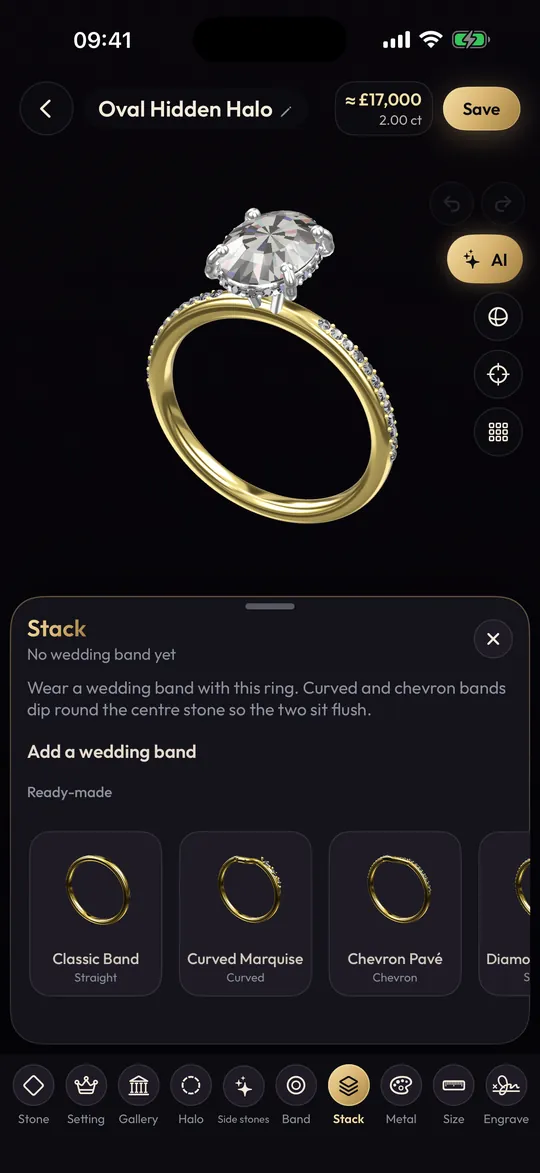
Ring Studio lets you design a wedding band on its own or stack it with an engagement ring, above or below, to see the pair together in 3D.
- Start a band on its own, or open an engagement ring design and add a band to the stack (stacks are part of Pro).
- Choose a style: plain, pavé, eternity, knife edge, twisted, bypass, asymmetric or engraved (vintage).
- Set it straight or tapered and adjust the width to match the engagement ring.
- Choose the contour: straight, curved or chevron, and check from the side that it sits flush.
- Try it above and below the engagement ring, pick the metal, and add engraving inside if you like.
- Share the ring code with your partner or jeweller.
How to choose between wedding band styles
Start with the engagement ring, since the band has to live beside it. Check whether a straight band will sit flush; if not, shortlist curved and chevron options. Next decide on sparkle: plain for durability, pavé or eternity for brilliance. Then match width and metal. If you want ideas for building up a stack over the years, see bridal sets and ring stacking ideas, and for budgets, wedding ring costs.
Frequently asked questions
What are the most popular wedding band styles?
Plain metal bands and diamond bands (pavé or half eternity) are the most widely worn. Contour bands have become popular for engagement rings with low settings or halos, and twisted and knife edge bands for a more distinctive look.
What width should a wedding band be?
Many women's bands are around 1.5 to 3 mm and many men's around 4 to 6 mm, but these are conventions, not rules. Matching the width of the engagement ring band usually looks best in a stack.
Should my wedding band match my engagement ring?
It does not have to, but matching the metal colour and band width usually looks most cohesive. Contrast in metal or texture can look great when it is clearly deliberate.
What is a contour wedding band?
A contour band is shaped to follow the outline of the engagement ring so the two sit flush. Common contours are gently curved, chevron (V-shaped) and notched.
Can you resize an eternity band?
Full eternity bands are very hard to resize because stones run all the way around. Half eternity bands, with stones across the top only, can usually be resized at the plain lower section.