 Ring Studio
Twisted Band Engagement Rings
A twisted band engagement ring has a band made of two or more strands wound around each other, like rope or a vine. It adds texture and movement to even a simple solitaire, and the twist is often read as a symbol of two lives intertwined.
On this page
- What it is
- A band of strands twisted around each other
- Variations
- Rope, vine, infinity, pavé twist, two-tone twist
- Best shapes
- Round, oval, pear, cushion; most shapes work
- Durability
- Good; plain twists are very sturdy
- Band pairing
- Usually easy with a straight band
- In Ring Studio
- Supported: twisted band option
How a twisted band is made
Two or more strands of metal are wound around each other and formed into the ring. Many modern twists are modelled in CAD and cast as one piece rather than literally twisted wire, which makes them stronger and lets the jeweller set stones along one strand. The twist can run all the way round, stop at the shoulders, or tighten as it approaches the stone.
Styles of twisted band
| Style | Look | Notes |
|---|---|---|
| Rope twist | Tight, even strands like rope | Nautical, classic |
| Vine or open twist | Looser strands with gaps | Botanical and romantic |
| Infinity twist | Two strands crossing in loops | Symbolic; often on shoulders only |
| Pavé twist | One strand plain, one diamond-set | Sparkle with texture |
| Two-tone twist | Strands in different metals | See two-tone gold |
Which stones suit a twisted band?
Almost any shape works, which makes twists easy to design. Rounds and ovals feel romantic with a vine twist; pears echo the curve of an open twist; and step cuts like emerald gain warmth from the texture. A twist busy with pavé suits a simpler stone and setting, while a plain metal twist pairs well with a halo or detailed head without the ring feeling crowded.
Effect on apparent size
A twist usually reads slightly wider than a smooth band of the same width because of the texture. Keep it slim, around 2 mm, if you want the centre stone to look as large as possible, and taper it towards the head. A chunky twist gives the ring presence but can compete with a small stone.
Comfort, durability and care
A plain metal twist cast in one piece is very sturdy. Pavé twists carry the usual small-stone maintenance. The grooves trap soap and lotion, so clean weekly with a soft toothbrush and warm soapy water, and dry with a soft cloth. White gold twists will need re-rhodium plating periodically to keep the grooves bright. Our care guide explains the full routine. Resizing is possible for most plain twists, but the jeweller must match the pattern at the join.
Wedding band compatibility
Twisted bands are usually straight, so a straight wedding band normally sits flush. Choices include:
- A matching twist: the two rings look like one braided band.
- A plain band: calm contrast that lets the twist stand out.
- A slim pavé band: extra sparkle without fighting the texture.
Cost of a twisted band
A plain twisted band typically costs a little more than a plain band of the same width because of the extra design and finishing, and more again with pavé on one strand. As an estimate, the difference over a plain band from the same jeweller is often modest. Prices vary by retailer, quality and metal market.
Choosing the right twist
Three decisions shape a twisted band:
- How tight the twist is. Tight twists look like rope and read as texture; loose twists with gaps between strands look lighter and more botanical.
- How far it runs. A twist only on the shoulders keeps the back of the ring smooth and comfortable; a full twist looks consistent from every angle.
- Plain or set. All-metal twists are the most durable and easiest to clean. A single pavé strand adds sparkle while keeping some plain metal for strength. Two pavé strands are the most dazzling and need the most care.
On smaller hands, a slim, tight twist keeps the ring in proportion. On larger hands, an open twist or a slightly wider band carries the detail better. If you are pairing the ring with a twisted wedding band, choose the same twist direction and tightness so the two read as one braid.
Designing a twisted band ring in Ring Studio
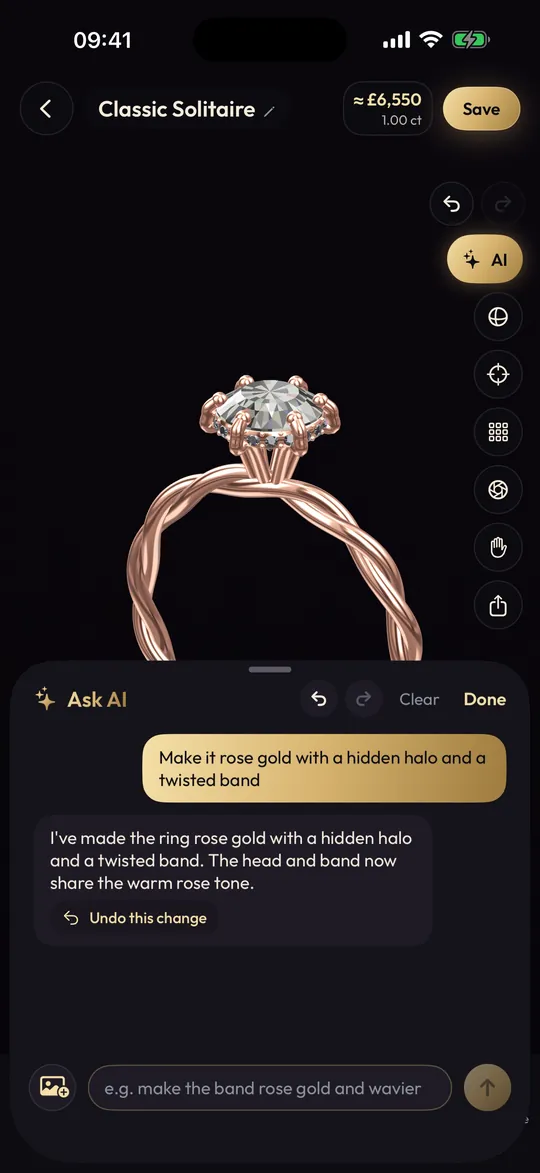
- Choose a centre stone, carat and setting.
- Pick twisted as the band type, then adjust the width and choose straight or tapered.
- Try different metals. With Pro, try two-tone for strands in different colours.
- Rotate and zoom on the shoulders to see where the twist meets the head.
- Open the wedding band stack to compare a plain band and a matching twist beside it.
If you already have a design in mind, the AI ring designer can build it from a sentence; asking it to "add a twisted band" is one of the quickest refinements.
Twisted band or another textured style?
If you like the twist but want more movement around the stone, look at bypass rings. If you want strands that open up near the head, see split shank rings. For sparkle along the band without texture, the pavé band is the classic alternative.
Frequently asked questions
What is a twisted band engagement ring?
It is a ring whose band is formed from strands twisted around one another, either plain metal, set with diamonds, or a mix. The twist usually runs at least up the shoulders to the head.
Are twisted band rings comfortable?
Most are, especially when the twist is only on the top half and the underside is smooth. Fully twisted bands can feel slightly textured between the fingers.
Do twisted bands get dirty?
The grooves between strands collect soap and lotion more than a smooth band does. A soft toothbrush and warm soapy water once a week keep them bright.
What wedding band goes with a twisted engagement ring?
A matching twisted band, a plain band for contrast, or a slim pavé band all work. Because twisted bands are usually straight, a straight wedding band normally sits flush.
Can twisted band rings be resized?
Plain metal twists can usually be resized by a size or so, although the jeweller has to match the twist at the join. Pavé twists are harder.