 Ring Studio
Bypass Engagement Rings
A bypass engagement ring has a band whose two ends sweep past each other around the centre stone instead of meeting in a straight line. The result is a flowing, asymmetric ring that feels both romantic and modern.
On this page
- What it is
- Band ends that sweep past each other around the stone
- Variations
- Plain, pavé, accent-stone tips, crossover, toi et moi
- Best shapes
- Round, oval, pear, cushion
- Durability
- Good; band ends can shield the stone
- Band pairing
- Usually needs a shaped band
- In Ring Studio
- Supported: bypass band option
How a bypass ring is built
On a standard ring, the band meets the head from directly opposite sides. On a bypass, each half of the band approaches the stone from a slightly different angle and slides past the other, so one shoulder sits higher on one side of the stone and the other sits lower on the opposite side. The centre stone is held in its own head between the sweeping ends, or partly cradled by them. From above, the band looks like an S-curve or a gentle swirl around the stone.
Bypass ring variations
- Plain bypass: smooth metal curves; sculptural and modern.
- Pavé bypass: small diamonds along one or both sweeping ends.
- Accent-tip bypass: each band end finishes in a small stone, giving a three-stone look on a diagonal.
- Toi et moi bypass: two main stones, one on each band end. See toi et moi rings.
- Crossover: the band ends cross completely, not just pass alongside.
- Subtle bypass: a slight offset, almost a solitaire, for a hint of movement.
Which stone shapes suit a bypass?
| Shape | Effect with a bypass band |
|---|---|
| Round | The swirl reads as movement around a still centre |
| Oval | The diagonal flow echoes the stone's curves |
| Pear | Natural partner; the band follows the teardrop |
| Cushion | Soft and romantic |
| Emerald, radiant | Angular contrast for a contemporary look |
| Marquise | Very dramatic; protect the points |
The bypass suits round and pear stones especially well.
Effect on apparent size
The band ends approach the stone diagonally and, when pavé set, add sparkle on two sides. This widens the ring's visual footprint without crowding the stone. A slim bypass makes a moderate stone look larger; a heavy bypass with thick ends can compete with it.
Durability and care
Bypass rings are generally sturdy. When the band ends wrap partway around the stone, they also protect its girdle. Watch for wear on any accent stones at the tips, and clean the gap between the band ends and the head where dirt gathers.
Wedding band compatibility
The asymmetric shoulders are the main complication. A straight band will touch the low side and leave a gap on the high side. Common solutions are a custom-shaped band, a curved wedding band, or wearing the wedding band on the opposite side of the engagement ring. Many people simply like the gap; it emphasises the bypass curve.
Cost of a bypass ring
A plain bypass costs roughly the same as a solitaire mount of similar weight, perhaps a little more for the shaping. Pavé or accent stones on the band ends add cost, and a toi et moi bypass with two featured stones costs the most. As an estimate, the uplift over a plain solitaire mount is usually modest. Prices vary by retailer, quality and metal market.
Choosing the amount of sweep
Bypass rings range from a barely offset band to a dramatic swirl, and the right amount depends on your hand and the stone:
- Slight offset: almost a solitaire. Easy to pair with a band and suits small stones.
- Moderate sweep: the classic bypass. Clear movement without overpowering a 1 carat stone.
- Full swirl or crossover: a statement. Suits larger stones and longer fingers.
Metal colour changes the effect too. In yellow or rose gold, the curves read as soft and organic; in platinum or white gold, they look sculptural and modern. A two-tone bypass, with each band end in a different colour, emphasises the idea of two paths meeting, which is one reason the style is popular for engagement rings.
Think about which hand you wear it on. The sweep reads differently on the left and right hand, and some designs are made in mirror image for this reason.
Designing a bypass ring in Ring Studio
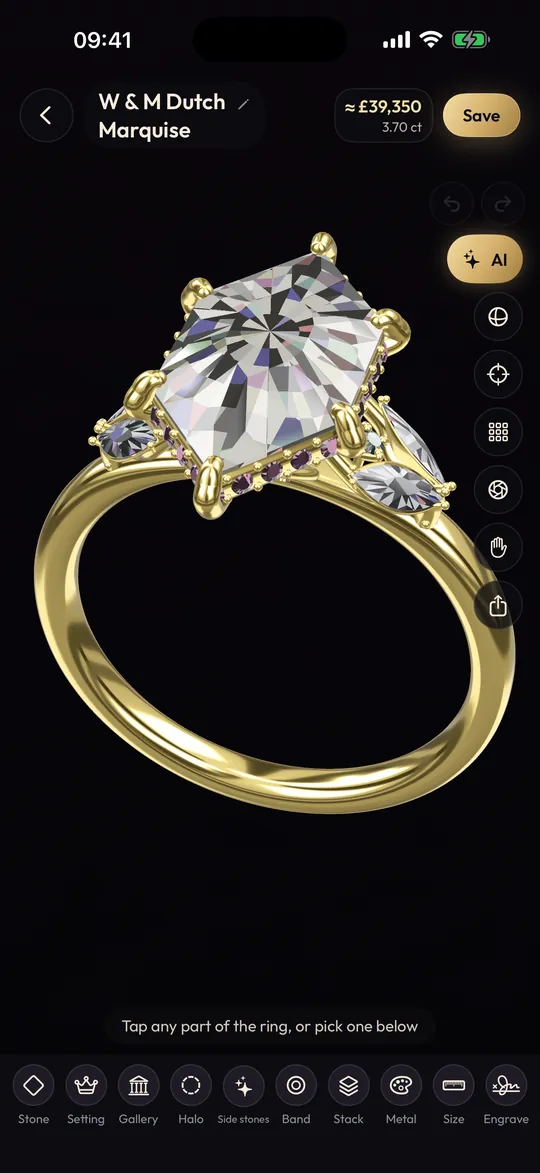
Ring Studio has a dedicated bypass band, so you can see the real shape in 3D:
- Choose your centre stone: try a pear or oval first.
- Pick a prong or bezel setting.
- Choose bypass as the band type, then compare it with the asymmetric band, which is another way to add movement.
- Adjust the band width and metal. Rose gold suits the romantic curves; platinum looks sculptural.
- With Pro, place your own extra stones on the band ends for an accent-tip or toi et moi look.
You can also ask the AI for "a pear diamond on a bypass band in rose gold", then refine by chatting.
Bypass or another statement band?
If you want movement in the band but a more classic outline, a twisted band keeps the symmetry. If you want two stones, look at toi et moi. For more individual looks, see our guide to unique engagement rings.
Frequently asked questions
What is a bypass ring?
It is a ring where the two ends of the band pass alongside each other, offset rather than meeting head-on. The centre stone sits between them, and sometimes each band end carries an accent stone.
What is the difference between a bypass and a toi et moi ring?
A bypass describes the shape of the band, and it can hold one stone or several. A toi et moi specifically has two featured stones; many toi et moi rings use a bypass band to hold them.
Do bypass rings look good with a wedding band?
They can, but the offset shoulders usually leave a gap with a straight band. A custom curved band or a slim band worn on the opposite side often works best.
Which diamond shape is best for a bypass ring?
Round, oval and pear are the most common, because curved outlines echo the flowing band. Angular cuts such as emerald work for a more contemporary contrast.
Are bypass rings durable?
Yes, generally. The band ends can wrap partly around the stone and protect it. Any accent stones on the band ends need the usual checks.
Keep reading
 Pear Engagement Rings: Choosing a Teardrop DiamondPear engagement ring guide: the best ratios, judging the bow-tie and shoulders, carat-to-mm sizes, protecting the tip, b…
 Round Engagement Rings: The Complete Buyer's GuideRound engagement ring guide: carat-to-mm sizes, cut grades that matter, best prong settings, band pairings and prices, p…Curved and Contour Wedding BandsCurved and contour wedding bands follow your engagement ring so they sit flush. See which rings need one, curve depth, w…