 Ring Studio
Ring Stacking Ideas
The best ring stacking ideas start from the engagement ring and build outwards: a band above or below, a contrast in texture or metal, and room to add anniversary rings later. Here are twelve stacks that work, plus the practical rules that stop a stack from twisting, gapping or rubbing.
On this page
- Start with
- The engagement ring's height, width and shape
- Comfortable count
- Two or three rings for most fingers
- Key fit issue
- Gaps from low settings and halos; solved by contour bands
- Contrast tools
- Metal colour, texture, stones, band profile
- In Ring Studio
- Stack a wedding band above or below your engagement ring (Pro)
Twelve ring stacking ideas
1. The classic pair
A solitaire with a plain band of the same width and metal, below it. Understated, durable and never out of date.
2. Solitaire plus pavé
A plain-band solitaire with a pavé wedding band. Sparkle runs right up to the stone, and the engagement ring still looks clean when worn alone.
3. The sandwich
The engagement ring between two bands, one above and one below. It frames the centre stone, protects it from side knocks and makes even a small stone look substantial. Often built over time, with the second band added at an anniversary.
4. Halo with a curved band
A halo ring usually overhangs the shank, so a curved band follows the halo's outline and closes the gap.
5. Pear with a chevron
A chevron band echoes the point of a pear or marquise. Stack two chevrons, above and below, for a starburst effect.
6. Mixed metals
A platinum engagement ring with a yellow gold band, or rose gold between two white bands. Works best when widths match so the colour contrast is the only variable. See two-tone and mixed metals.
7. Texture on texture
A twisted band beside a knife edge band, or an engraved vintage band beside a plain one. Contrasting textures keep a single-metal stack interesting.
8. The eternity stack
Engagement ring plus a half or full eternity band, later joined by another for an anniversary. Read more about eternity rings.
9. Coloured accents
A diamond engagement ring with a thin band of blue sapphires or rubies, or a coloured stone band as a birthstone tribute. Our birthstone rings guide has ideas.
10. Bypass and asymmetric
A bypass or asymmetric band beside a simple solitaire adds movement without competing with the stone.
11. The tapered trio
Three fine bands of slightly different widths or finishes with no engagement ring, a good choice for people who prefer bands to a centre stone.
12. The heirloom mix
A new engagement ring next to an inherited band, or an old ring redesigned to sit with a new one. See redesigning an old ring.
Stacking rules that actually matter
| Rule | Why |
|---|---|
| Match band widths, or step them deliberately | Random widths look accidental; matched or graded widths look planned |
| Check the fit from the side | Gaps from low settings and halos are the most common stacking problem |
| Keep the stack snug | Loose stacks spin and rub; very wide stacks may need a half size up |
| Consider metal hardness | Harder metals wear softer ones a little where they touch |
| Leave room to add | Anniversary bands and eternity rings need a place in the stack |
| Protect pavé edges | Stones on the edge of a band take the most rubbing from neighbours |
Above or below: does order matter?
By tradition the wedding band goes on first, below the engagement ring, so it sits closest to the heart. Practically, the ring nearest the hand gets less wear from the knuckle, and the ring at the top of the stack is the first thing people see. Many people put the wedding band on top for everyday comfort, or wear it below on special occasions. Some engagement rings only fit well in one order because of how the head overhangs. Try both.
How wide can a stack be?
Every ring you add widens the total band on your finger, and a wide stack covers more of the finger, which makes it feel tighter and restricts bending. As a rough guide, a total width of 6 to 8 mm is comfortable for most people; beyond that, a slightly larger size can help. The ring width guide explains the effect of width on sizing.
Stopping a stack from spinning
Engagement rings with tall heads tend to roll sideways. A band directly beside them can make it worse or better depending on fit. If yours rotates, consider sizing beads or a sizing bar from a jeweller, a slightly snugger size, or soldering the engagement ring and band together. See our bridal sets guide on soldering.
Testing stacks in Ring Studio
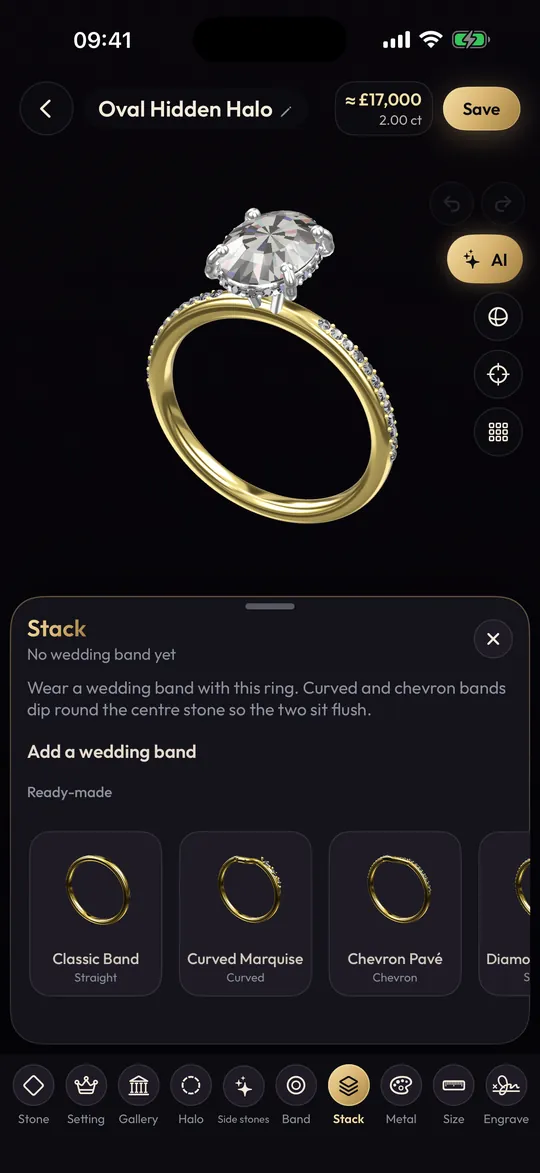
Ring Studio lets you put a wedding band beside your engagement ring and change everything about it, which makes it a quick way to test stacking ideas before you buy. Wedding band stacks are part of Pro.
- Open your engagement ring design, or recreate your existing ring by showing the AI designer a photo.
- Add a band to the stack and place it above or below.
- Cycle through band styles: plain, pavé, eternity, knife edge, twisted, bypass, asymmetric and engraved.
- Switch the contour between straight, curved and chevron to close any gap.
- Change metals to try mixed-metal stacks, and adjust the band width to match.
- Try it on your own hand with the camera, then share the ring code with your partner or jeweller.
Building a stack over the years
A stack does not need to be finished on the wedding day. Many people start with an engagement ring and a band, then add an eternity ring for a milestone anniversary or the birth of a child. If you think you will add rings later, choose a band style that leaves room: a matching plain band works with almost anything you might add. For ideas on what to add and when, see our guide to anniversary rings and the full wedding band styles overview.
Frequently asked questions
How many rings can you stack on one finger?
Two or three is common and comfortable for most people. Four or more works with fine bands, but wide stacks feel tight, restrict knuckle movement and may need a larger size.
Which order should you wear stacked rings in?
Tradition puts the wedding band below the engagement ring, closest to the hand. Many people now wear it above, or sandwich the engagement ring between two bands. Choose the order that looks and feels best.
Can you mix metals in a ring stack?
Yes. Mixed metal stacks look deliberate when there is a pattern, such as alternating colours or one contrast ring. Bear in mind that harder metals can wear softer ones slightly where they rub.
Why do my stacked rings keep spinning?
Top-heavy engagement rings and loose sizing make rings rotate. A snugger fit, a comfort-fit inside, a sizing aid from a jeweller or soldering the rings together can all help.
Do stacked rings damage each other?
Rings worn together rub over time, which can wear metal and loosen pavé stones on the edges. Matching hardness, keeping the stack snug and regular checks reduce the risk.