 Ring Studio
Engagement Ring vs Wedding Ring: What's the Difference?
The engagement ring vs wedding ring difference is about timing and design: an engagement ring is given at the proposal and usually features a centre stone, while a wedding ring (or wedding band) is exchanged during the ceremony and is usually a simpler band worn by both partners. Many people wear the two together.
On this page
- Engagement ring
- Given at the proposal; usually a centre stone; traditionally worn by one partner
- Wedding ring
- Exchanged at the ceremony; usually a band; often worn by both partners
- Usual order
- Wedding band closest to the hand, engagement ring outside
- Typical cost
- Engagement ring usually costs more than each wedding band
Engagement ring vs wedding ring at a glance
| Engagement ring | Wedding ring | |
|---|---|---|
| When it is given | At the proposal | During the wedding ceremony |
| Who wears it | Traditionally the person proposed to | Usually both partners |
| Typical design | Centre stone in a raised setting | A band: plain, pavé, eternity, patterned |
| Symbolism | A promise to marry | The marriage itself |
| Typical cost | Higher; driven by the centre stone | Lower; driven by metal and any stones |
| Who usually buys | Traditionally the proposer | Often bought together |
| Everyday wear | Some remove it for sport or work | Low profile, often never taken off |
The engagement ring
An engagement ring marks the agreement to marry. Most feature a centre stone, often a diamond, held in a setting that lifts it above the band. Common styles include solitaires, halos, three stone rings and side stone designs. Because of the centre stone, it is usually the more expensive of the two; see engagement ring costs for realistic ranges.
Traditionally one partner wears an engagement ring, though there is nothing to stop both doing so, and some couples choose matching engagement rings or swap for gemstone bands.
The wedding ring
A wedding ring, usually called a wedding band, is exchanged during the ceremony as a symbol of the marriage. Bands are designed for constant wear: lower profile, fewer things to snag, and often plain metal or securely set stones. Popular styles include plain bands, pavé, half or full eternity, and contoured bands shaped to fit around an engagement ring. Men's wedding bands are often wider and plain; see men's wedding band styles. For prices, see wedding ring costs.
Which finger, which hand, which order?
In the UK and US both rings usually go on the fourth finger of the left hand. Elsewhere, the right hand is traditional for one or both rings; our guide to which hand an engagement ring goes on lists customs by country.
On the same finger, many people wear the wedding band first, closest to the heart according to the old tradition, with the engagement ring outside it. On the day itself, some move the engagement ring to the other hand so the band can go on first, then put it back after the ceremony.
Making the two rings work together
This is the practical part people often leave too late. A solitaire with a low setting may let a straight band sit flush. A halo, a three stone or a low-set oval often needs a curved or contoured band, or a setting high enough for a straight band to slide under. Things to check:
- Metal: matching metals look seamless; mixing them is fine, but harder metal can wear softer metal over time where they rub.
- Width: a band slightly narrower than or equal to the engagement ring shank usually looks balanced.
- Profile: a band with the same profile and finish looks like a set.
- Comfort: two rings on one finger feel bigger; some people go up a quarter size.
A matched pair designed together is often called a bridal set.
Can one ring be both?
Yes. Some people choose a single band with stones as both engagement and wedding ring, or keep wearing only the engagement ring after the wedding. Others skip the engagement ring and invest in wedding bands. There is no rule; it is about what you will enjoy wearing.
Choose your priorities
Put more into the engagement ring if a centre stone matters to you and you want a statement piece for special occasions as well as daily wear.
Put more into the wedding ring if you prefer a simpler, low-profile ring you will wear constantly, or you want matching bands for both partners.
Design both rings together in Ring Studio
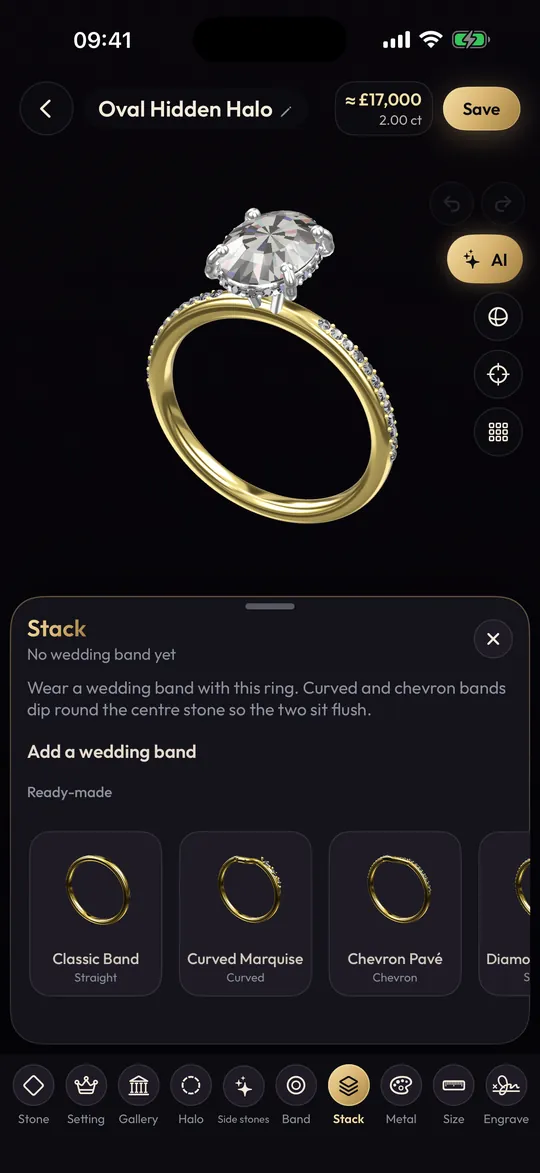
Ring Studio is built for exactly this. You can design an engagement ring and a wedding band and check how they sit together before speaking to a jeweller:
- Design the engagement ring: shape, carat, setting, halo, band and metal.
- Open the stack option (Pro) and add a wedding band above or below it.
- Choose a straight, curved or chevron contour so the band sits flush against the head.
- Try different band styles, from plain to eternity, and matching or contrasting metals.
- Try the pair on your hand with the camera (Pro) and share the ring code with your jeweller.
You can also design a wedding band on its own, for example a partner's band in a different width.
How much do people spend on each?
There is no correct amount. The engagement ring usually takes the larger share because of the centre stone, while wedding bands are mostly metal and labour unless you choose diamonds. If you are budgeting for all three rings at once, it helps to set one total and split it; our guide to setting an engagement ring budget explains a sensible approach without relying on old salary rules.
Verdict
An engagement ring is the proposal ring, usually with a centre stone; a wedding ring is the ceremony band, usually simpler and worn by both partners. If you plan to wear them together, design them as a pair from the start, so the band sits flush and the metals and proportions match.
Frequently asked questions
Do you need both an engagement ring and a wedding ring?
No. It is a tradition, not a rule. Some people wear only an engagement ring, some only wedding bands, and some choose a single ring that serves as both. Do what suits your budget and style.
Which ring goes on first?
In many Western traditions the wedding ring goes on first, closest to the hand, with the engagement ring outside it. Some people wear the engagement ring on the other hand on the wedding day and swap afterwards. Either order is fine.
Which hand do you wear an engagement ring and wedding ring on?
In the UK, US and many other countries, both go on the left ring finger. In parts of Europe and elsewhere, such as Germany, Poland and India, the right hand is common for one or both. Customs vary by country and family.
Do men wear engagement rings?
Increasingly some do, but it is still less common than wearing a wedding band. Men's engagement rings are often plain or lightly set bands.
Should the engagement ring and wedding band match?
They don't have to. Matching metals and a band that sits flush is the classic approach, but contrasting metals or textures can look deliberate and stylish. Try them together before buying.