 Ring Studio
Around the world
Engagement Rings in Japan: Sizes, Platinum and Customs
Engagement rings in Japan follow a distinct pattern: platinum is the default metal, sizes use the numbered gō scale, and the engagement ring is usually worn together with a matching wedding band as a set ring. Here is what is different, with a size conversion table and rough yen budgets.
On this page
- Japanese ring sizes (gō) and how they convert
- Which finger, and why the set ring matters
- Yuino and how proposals usually happen
- Platinum, Pt900 and the Japan Mint hallmark
- What Japanese buyers tend to prefer in a design
- How much engagement rings cost in Japan (rough estimate)
- Where couples shop
- Designing a Japanese-style set ring in Ring Studio
- Practical tips before you buy
- Size system
- Japanese numbered sizes (号, gō), roughly circumference in mm minus 40
- Which hand
- Left ring finger for engagement and wedding rings
- Usual metal
- Platinum (Pt900 or Pt950); 18k gold is the main alternative
- Purity mark
- Japan Mint hallmark, voluntary
- Typical style
- Slim, refined solitaires designed to sit with a matching band
- Rough budget
- About ¥150,000 to ¥600,000 for an engagement ring (estimate)
Japanese ring sizes (gō) and how they convert
Japan uses its own numbered scale, written with 号 (gō), as in 11号. The numbers climb by one for roughly every millimetre of inside circumference, so a quick rule of thumb is Japanese size ≈ inside circumference in mm minus 40. Size 9 is about 49 mm, size 13 about 53 mm. Japan shares this approach with Korea, which is why sizes on the South Korean page look so similar.
Charts published by different jewellers disagree by up to one size, especially when converting to US half sizes, so treat the table as a guide and confirm on a ring sizer in store. Our full international ring size chart and ring size converter cover every step.
| Japan (号) | Inside circumference (approx.) | US | UK | EU / ISO |
|---|---|---|---|---|
| 7 | 46.8 mm | 4 | H | 47 |
| 9 | 49.3 mm | 5 | J½ | 49 |
| 12 | 51.9 mm | 6 | L½ | 52 |
| 14 | 54.4 mm | 7 | N½ | 54 |
| 16 | 57.0 mm | 8 | P½ | 57 |
| 18 | 59.5 mm | 9 | R½ | 59.5 |
| 20 | 62.1 mm | 10 | T½ | 62 |
Japanese bands are often quite slim, which matters for sizing: a 1.8 mm band feels looser than a 3 mm band in the same size. If you are planning a wider ring, read the ring width guide before you order.
Which finger, and why the set ring matters
Couples in Japan wear both the engagement ring (婚約指輪, kon'yaku yubiwa) and the wedding ring (結婚指輪, kekkon yubiwa) on the left ring finger. The custom arrived with Western-style weddings in the twentieth century and is now near universal.
What is more distinctive is how the two rings are designed together. Many Japanese bridal shops sell engagement and wedding rings as a coordinated pair, often called a set ring (セットリング), with the band shaped to sit flush against the solitaire. Because many people wear only the wedding band day to day, especially at work, the band is designed to look complete on its own while also pairing neatly with the engagement ring on special occasions. Gentle curves, V shapes and slender twisted bands are common for exactly this reason. Our bridal sets guide explains how to plan two rings as one.
Yuino and how proposals usually happen
Yuino (結納) is the traditional betrothal ceremony in which the families meet and exchange symbolic gifts, such as dried kelp, dried squid or cuttlefish, folded fans and an envelope of money, each with an auspicious meaning. A full formal yuino is less common than it once was. Many couples now choose a lighter version or a family dinner (顔合わせ食事会, kaoawase shokujikai) at a hotel or restaurant, and the engagement ring may be presented there or simply given privately beforehand.
The proposal itself is often low-key and private. It is also common for couples to choose the ring together after the proposal, so the person proposing may present a placeholder ring or a loose diamond and then visit the jeweller as a pair. That habit makes design tools useful: you can agree the look together before anyone commits.
A small number of couples also give a return gift (婚約記念品) to the person who gave the ring, often a watch. This varies by family and is not an obligation.
Platinum, Pt900 and the Japan Mint hallmark
Platinum has been the standard bridal metal in Japan for decades. Two alloys dominate:
- Pt950: 95% platinum, the same standard used for most platinum jewellery in Europe.
- Pt900: 90% platinum, a little harder, and very common in Japanese bridal jewellery.
Both are naturally white and do not need rhodium plating, which is a large part of why Japanese buyers rarely choose white gold. Platinum develops a soft patina and scratches by displacing metal rather than losing it; our platinum vs white gold comparison covers that trade-off. 18k gold (K18), including pink gold, is the main alternative, often as a two-tone accent on a platinum ring.
Japan's precious metal purity marking is voluntary. The Japan Mint (造幣局) offers a hallmarking service, and pieces tested there carry a mark that includes the Japanese flag in a diamond-shaped outline next to the fineness figure. Many rings are instead stamped by the maker with marks such as Pt900 or K18, which is legal but not independently tested. If assurance matters to you, ask whether a ring has the Mint mark. Our hallmarks guide explains how marking systems compare internationally.
What Japanese buyers tend to prefer in a design
- Modest centre stones. Around 0.2 to 0.5 carats is common, with an emphasis on cut quality over size. A well-cut round brilliant is the classic choice.
- Low, smooth settings that do not catch on clothing or gloves.
- Slim, often curved or twisted bands designed to pair with the wedding ring.
- Small accent details, such as a tiny diamond set inside the band or a birthstone hidden underneath, reflect a taste for personal touches that only the wearer knows about.
The look is close to what Western shops call a minimalist engagement ring, with more attention paid to how it looks alongside its partner band.
How much engagement rings cost in Japan (rough estimate)
These are rough estimates for orientation only, not survey results. Prices vary widely by retailer, brand, diamond quality and the platinum price, and lab-grown diamond prices have fallen sharply in recent years.
| Type of ring | Rough range (JPY) |
|---|---|
| Platinum solitaire, small natural diamond (about 0.2 to 0.3 ct) | ¥150,000 to ¥350,000 |
| Platinum solitaire, natural diamond around 0.4 to 0.5 ct | ¥300,000 to ¥600,000 |
| Lab-grown diamond around 1 ct in platinum | ¥150,000 to ¥400,000 |
| Pair of matching platinum wedding bands | ¥150,000 to ¥350,000 for both |
For a wider view of what drives the number, see how much an engagement ring costs.
Where couples shop
Most couples buy from dedicated bridal jewellery shops, which are concentrated in districts such as Ginza in Tokyo and in major department stores across the country. Many of these shops let you combine a chosen diamond with a setting from their own range. Independent ateliers offer handmade rings and workshops where couples craft their own wedding bands. Online buying is growing, mainly for lab-grown stones and simpler bands. Whatever you choose, ask for the diamond grading report, the metal standard and the after-care terms, since resizing and cleaning are often free for life at the shop where you bought.
Japan's consumer rules give some protection for goods bought through door-to-door and telephone sales, but in-store purchases generally cannot simply be returned unless the shop's own policy allows it. Check the policy before paying.
Designing a Japanese-style set ring in Ring Studio
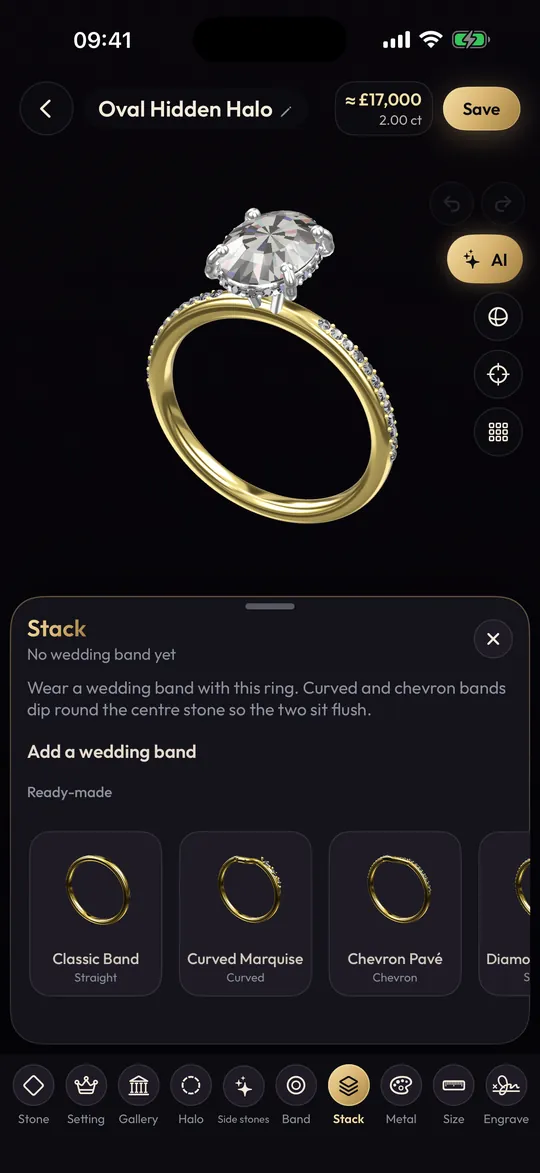
Ring Studio is a 3D ring designer for iPhone, iPad and Android. It is free to download from the App Store and Google Play, and the app is in English. It does not make or sell rings; you design and visualise, then take the design to a jeweller.
- Start with a round or oval stone and set the carat low, around 0.3 to 0.5, to match local taste.
- Choose platinum as the metal (the app does not let you pick Pt900 or Pt950; tell the jeweller which alloy you want).
- Pick a 4 or 6 prong setting with petite tips, and a tapered plain or twisted band at a slim width.
- With Pro, add a wedding band stack and set its contour to curved or chevron so it sits flush, the way a Japanese set ring does.
- Add hidden initials under the stone for a private detail, or plan an engraving inside the band.
- Share the ring code with your partner, then show the jeweller the design or screenshots so they can recreate it in their own CAD.
The live price estimate updates as you change stone and metal, which helps you compare options, though it is not a Japanese retail quote. The wedding band stack designer page explains the stacking tools in more detail.
Practical tips before you buy
- Measure the finger at the end of the day and in a warm room; fingers swell and shrink with temperature.
- If you plan to wear only the band at work, design the band first and make sure it looks finished on its own.
- Ask whether resizing is possible on the band style you choose; full eternity bands usually cannot be resized.
- Keep the grading report and receipt together for insurance and future servicing.
Frequently asked questions
What is the average ring size in Japan?
Many women in Japan wear roughly sizes 8 to 11 on the gō scale and many men roughly 15 to 19, but hands vary widely. Always measure rather than relying on an average.
How do Japanese ring sizes convert to US sizes?
The Japanese number is roughly the inside circumference in millimetres minus 40. Japanese 9 is close to US 5, Japanese 12 close to US 6 and Japanese 14 close to US 7, though charts differ by about one size.
Which hand do Japanese couples wear rings on?
The left ring finger is the norm for both the engagement ring and the wedding ring in Japan, a custom adopted from Western weddings during the twentieth century.
Why is platinum so popular for rings in Japan?
Platinum's white colour, weight and resistance to tarnish suited Japanese taste, and it became the standard bridal metal over the second half of the twentieth century. Pt900 and Pt950 are the common alloys.
What is yuino?
Yuino is a traditional betrothal ceremony in which the two families exchange symbolic gifts. Many couples now hold a simplified version or a family dinner instead, and the engagement ring is sometimes presented as part of it.