 Ring Studio
Around the world
Engagement Rings in Poland: Customs, Sizes and Gold
Engagement rings in Poland are traditionally worn on the right hand, as are wedding bands (obrączki). Most rings are 14 carat gold stamped 585 and checked by Poland's state assay offices, and sizes are usually given as a number derived from the circumference in millimetres.
On this page
- Engagement ring
- Pierścionek zaręczynowy, traditionally right hand
- Wedding band
- Obrączka, right ring finger
- Most common gold
- Próba 585 (14k); also 750 and 333
- Hallmarking
- State assay offices (urzędy probiercze)
- Size system
- Usually based on circumference in mm; check each shop
- Rough spend
- Often 1,500 to 8,000 zł for the ring (estimate)
Why Polish rings go on the right hand
In Poland the ring finger of the right hand is the traditional place for both the engagement ring and the wedding band. The custom has deep roots in Catholic tradition, where the right hand has long been associated with oaths and blessings, and it is shared with countries such as Germany, Austria, Russia and Ukraine.
The obrączka is placed on the right ring finger during the wedding, whether a church wedding (often a ślub konkordatowy, a church ceremony that also has civil effect) or a civil ceremony at the registry office (USC). The engagement ring is usually worn on the right too, and after the wedding most people stack it with the obrączka. Some prefer to keep the engagement ring on the left hand so each hand carries one ring, and couples where one partner is from abroad sometimes wear everything on the left. Our guide to which hand the engagement ring goes on compares customs worldwide.
Worn on the right hand, rings face more knocks for right-handed people, which is one reason many Polish couples prefer lower settings and sturdy bands. See engagement rings for an active lifestyle for settings that stand up to daily use.
Zaręczyny and the role of the ring
The proposal itself (oświadczyny) is usually a private moment, often followed by a family gathering to celebrate the zaręczyny. In some families the partner who proposes also asks the other's parents for their blessing, an older courtesy that many still enjoy observing. The engagement ring is typically a gold solitaire, very often with a diamond, though coloured stones such as sapphires have a long history in Polish jewellery too.
Wedding bands are usually bought together by the couple a few months before the wedding. Engraving the inside of the obrączki with the partner's name and the wedding date is close to universal, and many jewellers include it in the price. If you want something more personal, see what to engrave in a ring.
Polish ring sizes
Poland does not have one universal shop convention. Many Polish jewellers use a number derived from the inside circumference, commonly circumference in millimetres minus 40, the same convention used in Italy and Spain. Others quote the full circumference (for example 54) or the diameter. A size 14 from one shop and a size 54 from another can be the same ring, so ask.
| Common Polish size | Circumference | Diameter | US | UK |
|---|---|---|---|---|
| 9 | 49 mm | 15.6 mm | 5 | J½ |
| 12 | 52 mm | 16.5 mm | 6 | L½ |
| 14 | 54 mm | 17.2 mm | 7 | N½ |
| 17 | 57 mm | 18.1 mm | 8 | P½ |
| 20 | 60 mm | 19.1 mm | 9 | R½ |
| 22 | 62 mm | 19.7 mm | 10 | T½ |
Equivalents are approximate. Remember that the right hand is often slightly larger than the left for right-handed people, so measure the finger the ring will actually be worn on. The US to EU size table and how to measure ring size at home cover the details.
Próba 585 and Polish hallmarks
Polish gold is labelled by próba, the fineness in parts per thousand.
| Próba | Karat | Use in Poland |
|---|---|---|
| 333 | 8k | Budget jewellery; less used for engagement rings |
| 585 | 14k | The everyday standard for pierścionki and obrączki |
| 750 | 18k | Higher-end rings with a richer colour |
| 950 | Platinum | Premium white metal |
Poland has an independent state assay system. Regional assay offices (okręgowe urzędy probiercze, with branches in several cities) test precious-metal items and stamp them with an official assay mark, and items above small weight thresholds generally must carry it to be sold. Alongside the assay mark you will usually find a maker's mark. Check the official assay administration if you need the specifics. Our hallmarks guide explains how marks differ across countries, and 10k vs 14k gold covers why lower karats wear differently.
How much engagement rings cost in Poland
The figures below are rough estimates of common price points in złoty, not survey results. They move with the gold price, which affects plain obrączki most, and lab-grown diamond prices have fallen sharply over recent years.
| Ring | Rough range (PLN, estimate) |
|---|---|
| 585 gold ring with a small natural diamond (around 0.1 to 0.2 ct) | 1,500 to 5,000 zł |
| Natural diamond around 0.5 ct | 7,000 to 20,000 zł |
| Lab-grown diamond around 1 ct | 4,000 to 12,000 zł |
| Pair of plain 585 obrączki | 2,000 to 7,000 zł, mostly by weight |
For setting a sensible figure for your own situation, try the engagement ring budget guide rather than any salary rule.
Where to buy, and your basic rights
Poles buy from jewellery chains in shopping centres, independent jewellers and goldsmith workshops (pracownie złotnicze), and increasingly online. Workshops are the natural place for custom rings and for obrączki made to match a specific engagement ring.
In very general terms, Polish and EU consumer law gives you rights against faulty goods for two years and a 14-day withdrawal right for most online purchases, usually excluding items made to your specification. UOKiK, the competition and consumer protection office, publishes official guidance; this is not legal advice.
Designing a right-hand set in Ring Studio
Ring Studio is a 3D ring designer for iPhone, iPad and Android. It is free to download and the app is in English. It does not sell rings; you design the look and take it to a jeweller or pracownia, who makes it.
- Pick a stone shape and carat, then a setting. A bezel or low 4-prong head suits a ring that will take daily knocks on the right hand.
- Choose a metal colour. The app does not set karat, so ask the jeweller for 585 or 750.
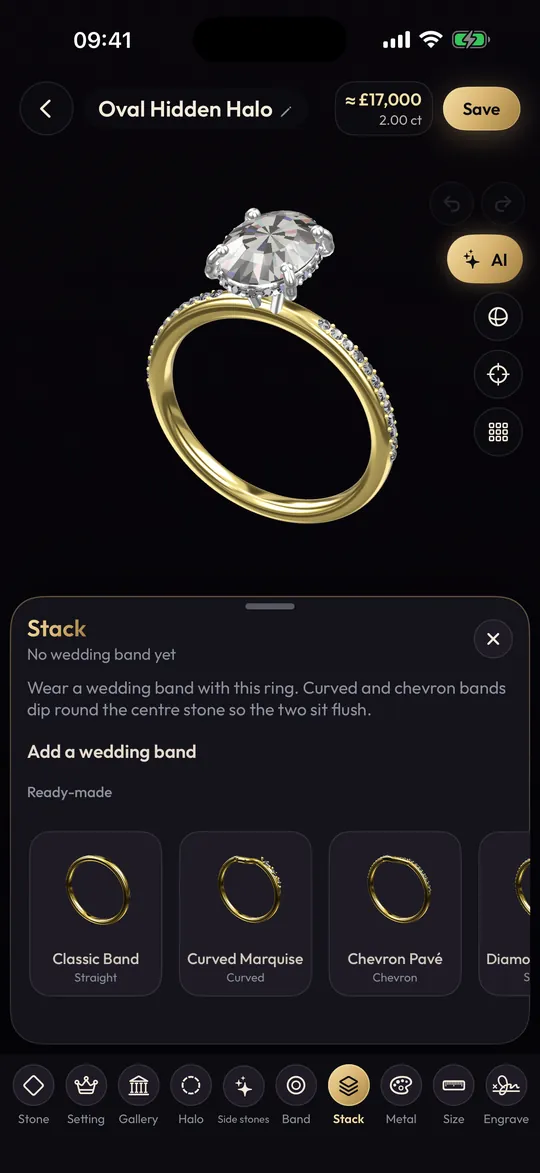
- Add a wedding band and stack it with the engagement ring. A curved or chevron contour lets the obrączka sit flush, which matters if both rings share the right ring finger.
- Engrave the inside of the band, and add hidden initials under the stone if you want a private detail.
- Share a ring code with your partner or jeweller.
The core designer is free; Pro unlocks the AI (describe a ring, or show a photo to recreate it), hand scan and try-on, band stacks and advanced options. See curved wedding bands for how contour bands work.
Frequently asked questions
Which hand do Poles wear engagement and wedding rings on?
Traditionally the right ring finger for both the pierścionek zaręczynowy and the obrączka. Some people wear the engagement ring on the left, and couples with international ties sometimes wear both on the left.
What does próba 585 mean?
Próba 585 means the gold is 585 parts per thousand pure, the same as 14 carat. It is the most common fineness for engagement rings and wedding bands in Poland. 750 is 18 carat and 333 is 8 carat.
Are gold rings hallmarked in Poland?
Yes. Poland has state assay offices that test precious-metal items and stamp them with an official mark. Items above small weight thresholds generally need this mark to be sold.
How do Polish ring sizes work?
Many Polish jewellers use a number based on inner circumference, often circumference in millimetres minus 40, so size 14 is about 54 mm. Others quote the full circumference or diameter, so always check which system a shop uses.
How much does an engagement ring cost in Poland?
As a rough estimate, a gold ring with a small diamond often costs around 1,500 to 5,000 zł, while larger natural diamonds can run well into five figures. Prices vary with the gold price, stone quality and shop.