 Ring Studio
Around the world
Engagement Rings in Brazil: Alianças, Solitários and Sizes
Engagement rings in Brazil work differently from most countries: both partners usually wear a matching gold aliança on the right hand while engaged, then move it to the left hand at the wedding. A diamond solitário is increasingly added on top. Here is how sizes, gold and budgets work.
On this page
- Key ring
- Aliança de noivado, worn by both partners
- Engaged
- Right ring finger
- Married
- Moves to the left ring finger
- Gold standard
- 18k (ouro 750)
- Sizes
- Brazilian aro numbers (roughly circumference minus 40)
- Consumer law
- Código de Defesa do Consumidor; complaints via PROCON
The aliança: Brazil's two-ring tradition
In much of the world, one person receives an engagement ring. In Brazil the classic gesture is a pair of matching gold bands, the alianças de noivado. Both partners wear theirs on the right ring finger during the engagement. On the wedding day the bands are blessed and placed on the left ring finger, marking the change from noivos to married.
Alianças are traditionally engraved inside with the partner's name and the date of the noivado or wedding. A plain polished band is the classic look, but there are now many variations: a line of small diamonds on one band, a satin finish, two-tone stripes or a softly domed profile.
Before the noivado, many couples wear an aliança de compromisso, a promise ring, also on the right hand. It is often in silver or a lighter gold band. Our guide to promise rings covers similar customs elsewhere.
Where the solitário fits in
The diamond anel de noivado or solitário has become much more common in Brazilian proposals, especially in big cities. Couples who use one often follow a mixed approach: the solitário at the proposal, the pair of alianças at the noivado party or soon after, and all three rings settled on the left hand after the wedding, with the solitário stacked above or below the aliança.
That stack is worth planning in advance. A high solitário setting will sit happily over a straight aliança, but a low one may need a curved band to sit flush. Religious practice varies, and evangelical, Catholic and secular couples may keep or skip parts of these customs.
Brazilian ring sizes (aro) explained
Brazil uses its own size numbers, called aro or numeração. As a rule of thumb the number is close to the inside circumference in millimetres minus 40, but charts differ by a size or so between jewellers. The table is an approximation; always confirm with the jeweller's own ring gauge.
| Circumference | Approx. Brazil aro | US size | EU/ISO |
|---|---|---|---|
| 49.3 mm | 9 | 5 | 49 |
| 51.9 mm | 12 | 6 | 52 |
| 54.4 mm | 14 | 7 | 54 |
| 57.0 mm | 17 | 8 | 57 |
| 59.5 mm | 19 to 20 | 9 | 59-60 |
| 62.1 mm | 22 | 10 | 62 |
Alianças are often wider than international wedding bands, sometimes 4 to 6 mm or more, and wider bands feel tighter. Many Brazilian jewellers advise going up half a size or one aro for a wide band. Our diameter and circumference chart helps if you have measured in millimetres.
Ouro 18k: why purity matters for alianças
Brazilian alianças are traditionally made in 18k gold, stamped 750 (75% gold). It gives a deep yellow colour that suits a plain band. 14k or lower-karat gold exists, as do gold-plated (folheado) rings, which are far cheaper but wear through over time. Always look for the stamp and make sure the karat is on the nota fiscal.
| Type | Gold content | Notes |
|---|---|---|
| Ouro 18k (750) | 75% | The standard for alianças |
| Ouro 14k (585) | 58.3% | Harder, slightly paler, cheaper |
| Folheado a ouro | Thin gold layer | Plated; not solid gold |
Because a pair of solid 18k bands contains a lot of gold, the gold price is the biggest driver of cost. Heavier bands cost more, so width and thickness are worth deciding consciously. See 14k vs 18k gold.
Rough budgets in reais
These are rough estimates only, not survey figures. Prices depend on band weight, the daily gold price, the stone and the jeweller, and lab-grown diamond prices have dropped sharply in recent years.
- Pair of 18k alianças: often somewhere around R$1,500 to R$8,000, mostly driven by weight and width.
- Solitário: roughly R$2,000 to R$20,000+, depending on whether the diamond is natural or lab-grown and its size.
Brazilian consumer law (the Código de Defesa do Consumidor) gives a seven-day right of withdrawal for purchases made outside a physical shop, such as online. Complaints can go to your state PROCON. Custom engraved pieces may have different terms, so check before you order. This is general information, not legal advice.
Where Brazilians buy
Shopping-centre jewellers, independent ourives (goldsmiths) and online alliance specialists all compete heavily. Many couples visit two or three shops to compare gram weight and price per gram, which is a fair way to compare plain 18k bands.
Design your alianças and solitário in Ring Studio
Ring Studio is a free 3D ring designer for iPhone, iPad and Android (the app is in English). It is ideal for deciding how the aliança and solitário will look together before you visit an ourives.
- Design a plain or pavé band on its own, adjusting width, then choose yellow gold for a classic aliança.
- Design the solitário: pick a shape, carat, and 4 or 6 prong setting.
- With Pro, stack the band with the solitário using the wedding band stack designer, and choose a straight, curved or chevron contour.
- Add engraving inside the band for the name and date; see engraving ideas.
- Share a ring code or screenshots with the jeweller, who confirms the 18k and recreates the design.
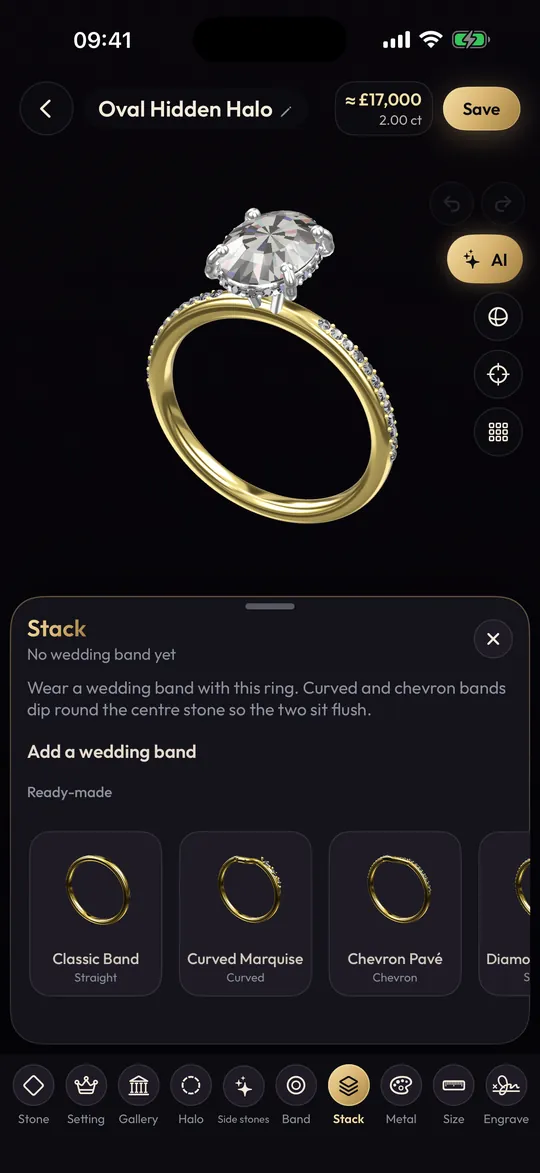
Choosing aliança width and profile
Because both partners wear the aliança every day for decades, comfort matters as much as looks. Narrow bands of around 2 to 3 mm suit a slim finger and a solitário stack; wider bands of 5 to 6 mm or more make a bolder statement and are common for men. A gently rounded inner edge feels kinder on the knuckle, and a flat or domed outer face changes how the band catches light.
Popular Brazilian variations include a polished band with a satin centre stripe, a white and yellow gold mix, and a single small diamond set flush into the bride's band. If you choose a mixed-metal look, ask how it will be finished, since white gold needs replating over time. See our ring width guide and two-tone gold page.
Checklist for buying alianças
- Measure both partners with the jeweller's gauge, allowing for width.
- Confirm 18k (750) on the stamp and the nota fiscal.
- Compare gram weight as well as the total price.
- Agree engraving text, font and delivery date in writing.
Frequently asked questions
Which hand is the aliança worn on in Brazil?
During the noivado (engagement) both partners usually wear the aliança on the right ring finger. At the wedding it moves to the left ring finger, often after the officiant blesses the rings.
What gold is used for Brazilian alianças?
18k gold, marked ouro 18k or 750, is the traditional standard. Lower-purity and plated rings exist, so check the stamp and the invoice.
How do Brazilian ring sizes (aro) work?
Brazilian jewellers number sizes on their own aro scale, which roughly follows the inside circumference in millimetres minus about 40. Charts vary slightly between shops, so measure with the jeweller's own gauge if you can.
Do Brazilians use engagement rings with diamonds?
Increasingly, yes. Many couples combine the traditional pair of alianças with a solitário for the bride, often worn together on the left hand after the wedding.
What is an aliança de compromisso?
A promise ring, often in silver or gold, that couples wear on the right hand while dating seriously, before the formal engagement alianças.