 Ring Studio
Ring designer
Men's Wedding Ring Designer
Ring Studio works as a men's wedding ring designer for the decisions that change how a band looks: width, metal, surface style and engraving. A few technical choices, like the comfort-fit profile, are made with your jeweller, and this page explains which.
On this page
- Design in the app
- Band style, width, metal, two-tone, stones, engraving
- Agree with jeweller
- Profile (court, D-shape, flat, comfort fit), karat, finish depth
- Metals in app
- Yellow, white and rose gold, platinum, two-tone
- Not in app
- Tungsten, titanium, palladium, carbon, wood
The four decisions that shape a men's wedding ring
Men's wedding bands look simple, which makes each choice more visible. Most come down to four things: width, metal, surface and profile. You can see the first three in 3D in Ring Studio; the fourth is a conversation with your jeweller.
1. Width
| Width | Look | Suits |
|---|---|---|
| 3-4 mm | Slim, understated | Slim fingers, people who rarely wear jewellery |
| 5-6 mm | Classic | Most hands; a safe default |
| 7-8 mm | Bold, substantial | Larger hands; anyone who wants presence |
A wider band feels tighter than a narrow one of the same size, so some people go up half a size for 7 mm and above. The ring width guide explains why.
2. Metal
Ring Studio offers yellow, white and rose gold, platinum and two-tone (Pro). Platinum is heavy and naturally white. White gold is usually rhodium plated, which wears and needs replating over time (see rhodium plating). Yellow gold is having a revival in men's bands. If you want tungsten, titanium or palladium, those aren't in the app; design the look in white gold or platinum and specify the metal with your jeweller. Our tungsten vs titanium comparison covers the trade-offs, including the difficulty of resizing them.
3. Surface and style
The band styles in Ring Studio that suit men's rings:
- Plain: the classic. Choose polished or ask your jeweller for a matte or brushed finish.
- Knife edge: a ridge along the top that catches light; sharper and more architectural.
- Twisted: a rope-like texture.
- Engraved: vintage-style pattern around the band.
- Pavé or eternity: a row of stones for more sparkle.
- Two-tone (Pro): combine two metal colours.
4. Profile, set with your jeweller
The cross-section of the band matters for comfort. Common profiles are court (rounded inside and out), D-shape (flat inside, domed outside), flat, and comfort fit (rounded on the inside, sometimes heavier). Ring Studio doesn't have dedicated profile options yet, so pick the look and width in the app, then tell the jeweller which profile you want. More in men's wedding band styles.
How to design a men's wedding band in Ring Studio
- Start a new design and choose a band on its own (no centre stone).
- Pick the style: plain, knife edge, twisted, engraved, pavé or eternity.
- Set the band straight rather than tapered, and adjust the width until it looks right.
- Choose the metal, or two-tone with Pro.
- Add an engraving inside the band.
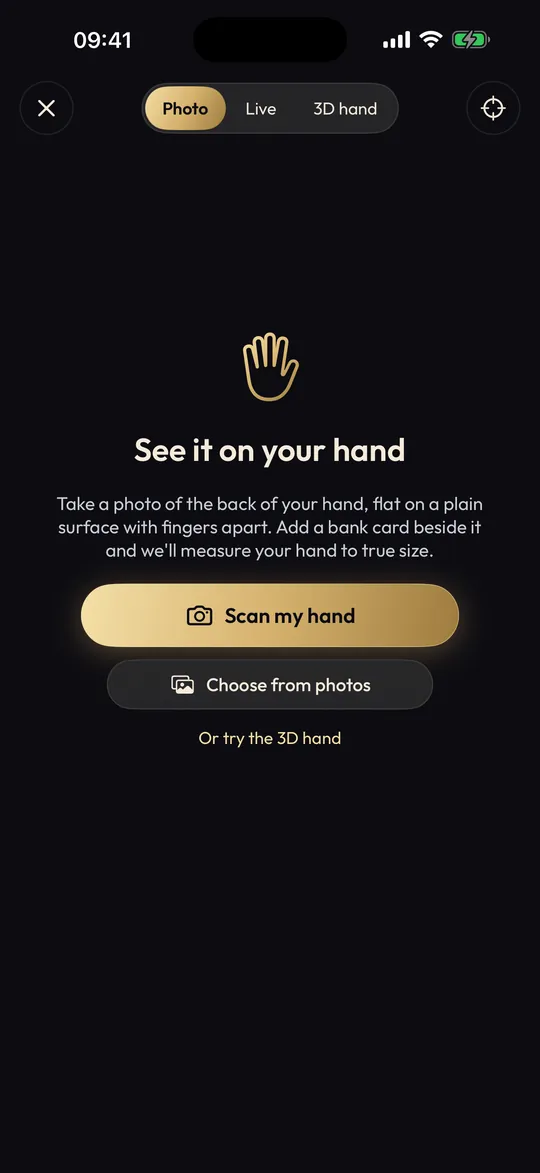
- With Pro, try it on with the camera, ideally on the wearer's own hand, and scan the hand to estimate size.
- Screenshot it, and write the profile, karat and finish you want alongside.
Matching his and hers (or his and his) bands
Couples often want bands that relate without being identical: the same metal in different widths, or the same knife edge style in two sizes. Design both bands in Ring Studio and compare them side by side. If one partner's band stacks with an engagement ring, design that one first with the stack (Pro) so the shape is settled, then echo its style in the other.
Engraving ideas and practicalities
Inside engraving is the most personal part of a men's band. A 6 mm band gives more room for characters than a 3 mm one. Dates, initials, coordinates and short phrases are favourites; our list of what to engrave in a ring has plenty more. Hand engraving costs more than machine engraving; see ring engraving cost.
Durability for everyday wear
A men's band often takes harder knocks than an engagement ring, especially for anyone who works with tools or lifts weights. All precious metals scratch; the question is how they age. Platinum develops a soft patina rather than losing metal. Lower-karat golds are harder than 18k, so 9k or 14k suits heavy wear. Pavé and eternity bands look superb but can lose small stones over years of impact. See ring care for cleaning and checks.
Taking the design to a jeweller
Bring screenshots, or a ring code (Pro), plus a short spec: width in millimetres, profile, metal and karat, finish (polished, brushed, matte), engraving text, and size. Ring Studio doesn't make rings or export manufacturing files; the jeweller makes the band to your spec. Plain gold and platinum bands are among the simplest rings to make, so lead times are often shorter than for engagement rings.
Frequently asked questions
What width should a men's wedding ring be?
Most men's bands fall between about 4 mm and 8 mm, with 5-6 mm the most common middle ground. Larger hands and fingers usually suit wider bands; slim fingers or a stacked engagement ring suit narrower ones.
What is a comfort-fit wedding band?
A comfort-fit band is rounded on the inside so it slides over the knuckle more easily and feels less tight. Ring Studio doesn't have a profile option for it yet, so ask your jeweller to make your design comfort fit.
What is the most durable metal for a men's wedding ring?
Among precious metals, platinum is dense and holds its metal when scratched, and 14k or 9k gold is harder than 18k. Tungsten and titanium are very scratch resistant but can't easily be resized; those alternative metals aren't options in Ring Studio.
Can I design a men's ring with diamonds?
Yes. A pavé or eternity band adds stones; a single flush-set diamond is a classic men's look that you'd describe to your jeweller, as Ring Studio's band styles don't include a flush-set option.
What should I engrave inside a men's wedding ring?
Popular choices are the wedding date, initials, coordinates of where you met or a short phrase. Keep it short on a narrow band; wider bands fit more characters.