 Ring Studio
Knife Edge Engagement Rings
A knife edge engagement ring has a band that rises to a narrow ridge along the top, so it looks slimmer from above and catches light along the edge. It is a quietly sophisticated way to make the centre stone look larger.
On this page
- How a knife edge band is shaped
- Knife edge vs other band profiles
- Why knife edge bands make stones look bigger
- Which stones suit a knife edge band?
- Durability and maintenance
- Wedding band compatibility
- Cost of a knife edge band
- What to ask for when ordering a knife edge band
- Designing a knife edge ring in Ring Studio
- Is a knife edge band right for you?
- What it is
- A band peaking to a ridge along the top
- Effect
- Looks slim from above; catches light on the edge
- Best with
- Solitaires and hidden halos; any shape
- Durability
- Strong for its apparent width
- Band pairing
- Easy; usually sits flush with a straight band
- In Ring Studio
- Supported: knife edge band option
How a knife edge band is shaped
A standard band is flat or gently domed on top. A knife edge band is shaped so both sides slope up to a central ridge. Viewed end-on, its cross-section looks like a triangle or a tall rounded peak. The ridge is softened, not sharp, but crisp enough to catch a line of light as the hand moves. Some designs run the ridge all the way round; others use it only on the top half and transition to a rounded profile underneath for comfort.
Profiles like this are part of what jewellers call the band's cross-section; our ring anatomy guide explains the terms.
Knife edge vs other band profiles
| Profile | Look from above | Strength for apparent width | Feel |
|---|---|---|---|
| Knife edge | Very slim line | High | Crisp |
| Flat | Full width visible | Moderate | Modern |
| Court or domed | Soft rounded surface | Moderate | Smooth, traditional |
| Tapered | Narrows towards stone | Moderate | Elegant |
Our ring width guide explains how width and profile interact.
Why knife edge bands make stones look bigger
From above, a knife edge band reads as a fine line rather than a strip of metal. The contrast between a thin line and the stone makes the stone look larger. Because the metal is deep rather than wide, you get that slim look without the bending risk of a very thin flat band, which is the real advantage over simply asking for a 1.5 mm band.
Which stones suit a knife edge band?
All shapes work. Knife edge bands look especially good with solitaires, where the clean, sharp line matches a minimal design. With step cuts such as emerald and asscher, the crisp edge echoes the stone's facets. With rounds and ovals, it adds a modern contrast to curved outlines. Hidden halos also pair well, because the knife edge keeps the top view clean.
Durability and maintenance
A knife edge band is strong for its apparent width. Over many years, the ridge can soften slightly with wear, especially in softer metals; platinum tends to move rather than lose metal, while white gold may need re-plating to stay bright. For a comparison of how the two wear, see platinum vs white gold. A jeweller can sharpen the line again during refinishing. Cleaning is easy: no grooves or stones to trap dirt.
Wedding band compatibility
Knife edge engagement rings are usually straight, so a straight wedding band sits flush. A matching knife edge wedding band creates a crisp double line; a flat or court band offers a softer contrast. For more options, see wedding band styles.
Cost of a knife edge band
A knife edge band uses a similar amount of metal to a standard band of the same depth, and costs about the same, sometimes slightly more for the finishing. It is one of the lowest-cost ways to give a solitaire a more refined look. Prices vary by retailer, quality and metal market.
What to ask for when ordering a knife edge band
- Width at the base and depth. These two measurements, in millimetres, define how slim it looks and how strong it is.
- How sharp the ridge is. Some jewellers make a crisp peak; others a softer, rounded ridge. Ask to see examples.
- Full or half knife edge. A knife edge on the top half only, transitioning to a rounded underside, is often the most comfortable.
- Tapered or straight. A tapered knife edge narrows towards the head for the slimmest look.
- Matching wedding band. If you want a pair, order them together so the profiles match.
A knife edge also pairs well with a high polish, which makes the line of light along the ridge more visible. A satin finish gives a softer, more modern look.
Designing a knife edge ring in Ring Studio
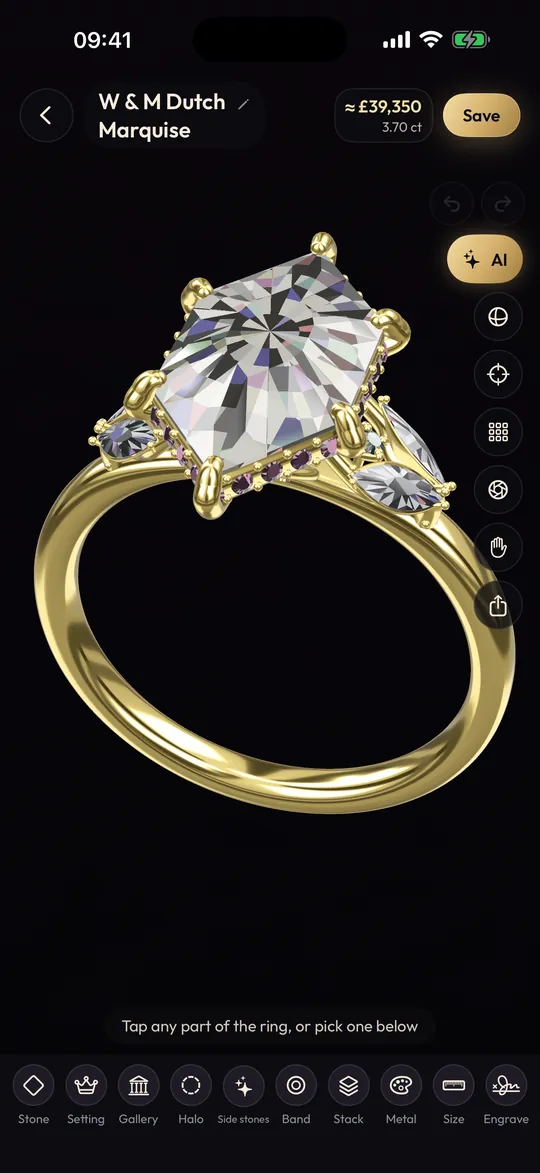
- Choose your stone shape, carat and setting.
- Pick knife edge as the band type.
- Choose straight or tapered. A tapered knife edge is the slimmest-looking option.
- Rotate the ring end-on to see the ridge, and adjust the width.
- Compare platinum and yellow gold to see how the edge catches light.
Is a knife edge band right for you?
Choose a knife edge band if you want a refined solitaire with a crisper line, or want the stone to look larger without a fragile band. For a full pared-back look, see minimalist engagement rings.
Frequently asked questions
What is a knife edge band?
It is a band whose top surface slopes up from both sides to meet in a ridge, like the blade of a knife viewed end-on. The edge is rounded off so it is not sharp to touch.
Is a knife edge band comfortable?
Yes. The ridge is on the outside and is softened, and the inside is usually smooth or slightly rounded. Most people cannot tell the difference in comfort from a standard band.
Does a knife edge band make the diamond look bigger?
It helps, because the ridge reads as a thin line from above, so the stone looks larger in comparison. It does this without being as fragile as a very thin flat band.
Is a knife edge band strong enough?
Yes. Because the metal is deep rather than wide, a knife edge band can be stronger than a flat band that looks the same width from above.
Does a knife edge band wear down?
The ridge can soften slightly over many years of wear, particularly in softer gold. A jeweller can refinish it during a polish.