 Ring Studio
Black Diamond Engagement Rings
Black diamond engagement rings are bold, graphic and far cheaper than colourless diamonds of the same size. Most black diamonds on the market are treated to get their colour, so knowing what you are buying matters more than with almost any other stone.
On this page
- What is a black diamond?
- Natural vs treated black diamonds
- Are black diamonds durable enough for everyday wear?
- Which metals and styles suit a black diamond?
- How much does a black diamond engagement ring cost?
- Caring for a black diamond ring
- Designing a black diamond ring in Ring Studio
- Is a black diamond right for you?
- Hardness
- 10 on the Mohs scale (same as any diamond)
- How most get their colour
- Treatment: irradiation, heating or HPHT of included or low-grade diamonds
- Natural black diamonds
- Exist but are uncommon; colour comes from dense dark inclusions such as graphite
- Look
- Opaque with a glossy, metallic surface lustre rather than sparkle
- Durability watch-out
- Often heavily included, so more prone to chips than a clean diamond
- Best settings
- Bezel, six prongs or a hidden halo for protection and contrast
What is a black diamond?
A black diamond is a diamond that looks opaque black face-up. Chemically it is the same carbon crystal as a clear white stone, and it is just as hard. What makes it different is how light behaves: a colourless diamond lets light in and bends it back out as brilliance and fire, while a black diamond absorbs or blocks almost all of it. The result is a stone that reads as a sleek, dark mirror, with every facet edge catching a crisp line of reflection.
Because the look is so different, black diamonds are bought for character rather than sparkle. They suit people who want an engagement ring that does not look like everyone else's, and they pair beautifully with white diamonds, which pop against the dark centre.
Natural vs treated black diamonds
This is the single most important thing to understand before buying. The vast majority of black diamonds sold in engagement rings have been treated. Jewellers take diamonds that are heavily included, cloudy or an unattractive brown or grey (stones with little value as white diamonds) and change their colour.
| Type | How the colour forms | What to expect |
|---|---|---|
| Irradiated | Exposure to radiation, usually followed by heating, turns the stone a very dark green that looks black face-up | The most common route; stable colour; may show a green tint under strong light |
| Heat-treated | High heat graphitises fractures and inclusions so the stone turns black | Very common for heavily fractured stones; those fractures remain, which affects durability |
| HPHT-treated | High pressure, high temperature processing alters colour | Used for some colour changes; disclosure is essential |
| Natural (untreated) | Dense dark inclusions such as graphite, sometimes in polycrystalline form like carbonado | Uncommon and harder to cut; should come with a lab report confirming natural colour |
| Lab-grown | Grown with dark inclusions or treated after growth | Same diamond material; should be disclosed as laboratory-grown |
Treatment is not a scandal in itself. Treated black diamonds are permanent in normal wear and are an honest product when sold as such. The problem is non-disclosure. If you are paying a premium for "natural colour", ask for a report from a recognised laboratory; our guide to diamond certificates explains which labs and what to look for.
Avoid confusing black diamonds with black moissanite, black spinel, black onyx or black cubic zirconia. They can look similar in photos but have very different hardness and value. Ask exactly what the stone is and get it in writing.
Are black diamonds durable enough for everyday wear?
Black diamonds share diamond's 10 on the Mohs hardness scale, so they resist scratching better than any other gemstone. Hardness is not the same as toughness, though. Many black diamonds started life full of fractures and inclusions, and treatment does not heal them. That makes some stones more likely to chip at a sharp corner or along a weak plane if knocked hard.
Polishing is also harder. Natural black diamonds with dense inclusions are notoriously difficult to cut, which is why you sometimes see slightly pitted or less crisp facet surfaces. Inspect the stone under magnification, or ask for a close-up video, before you commit.
Practical ways to protect a black diamond:
- Choose a bezel setting, which wraps the girdle and guards the edges, or use six prongs rather than four.
- Prefer shapes without sharp points, such as round, oval or cushion, or protect the points of pear and marquise shapes with V-prongs from a jeweller.
- Take the ring off for gym sessions, gardening and heavy work. Our guide to rings for an active lifestyle covers this in more detail.
Which metals and styles suit a black diamond?
Metal colour changes the mood of a black diamond ring more than with almost any other stone.
- Rose gold gives a warm, romantic, slightly gothic contrast and is the most popular partner for black diamonds.
- White gold or platinum looks cool and modern, especially with a halo of white diamonds around the black centre.
- Yellow gold gives a rich, almost antique look that suits vintage cuts and engraved bands.
Popular designs include a black centre with a white diamond halo for maximum contrast, a black diamond solitaire on a plain band for minimalism, and a three stone ring with a black centre flanked by white side stones. Rose cut and old-cut shapes, with their large, flat facets, show off the mirror-like surface particularly well.
How much does a black diamond engagement ring cost?
Treated black diamonds are among the cheapest diamonds you can buy per carat, which is a big part of their appeal. A one carat treated black diamond typically costs a small fraction of a colourless natural diamond of the same weight. Natural, untreated black diamonds with a lab report command a premium, and lab-grown black diamonds sit at the low end too.
The setting often costs more than the stone. Metal choice, a pavé or halo of white diamonds, and the jeweller's labour drive most of the final price. As a rough guide, many treated black diamond engagement rings sell in the low hundreds to low thousands of pounds (GBP), but prices vary widely by retailer, quality, metal prices and design. For a broader view, see how much an engagement ring costs.
Caring for a black diamond ring
Clean with warm water, a drop of washing-up liquid and a soft toothbrush. Black diamonds show fingerprints and oil films more obviously than white diamonds because the glossy surface acts like a mirror, so a quick polish with a lint-free cloth makes a visible difference. Avoid ultrasonic and steam cleaners for heavily included or fracture-filled stones, since vibration and heat can worsen existing fractures. Have the prongs checked once a year. Our engagement ring care guide has the full routine.
Designing a black diamond ring in Ring Studio
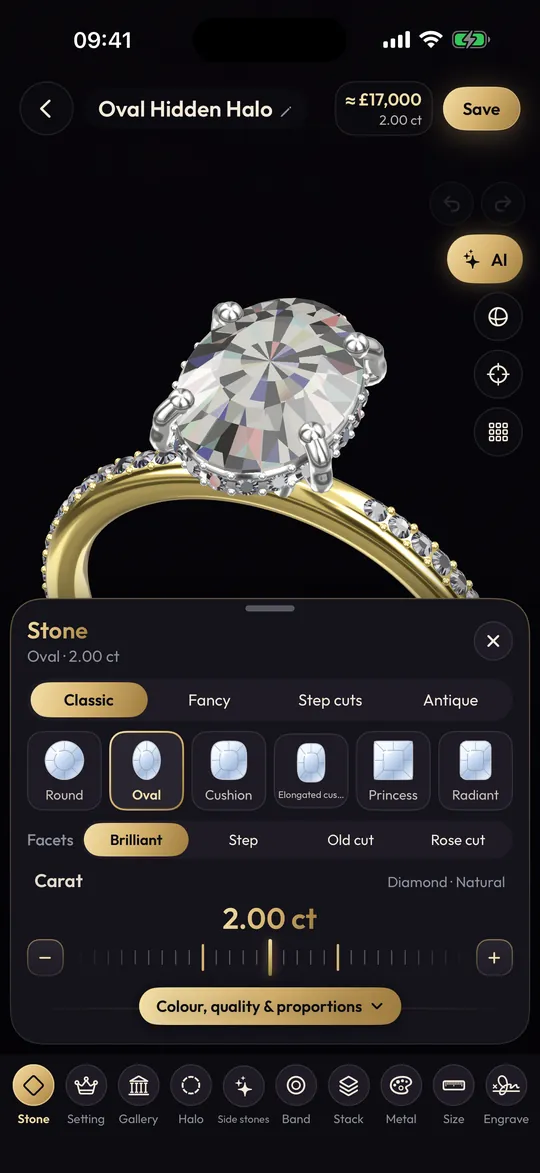
Ring Studio includes black diamonds as a stone option, so you can see exactly how the dark centre reads against different metals before you talk to a jeweller.
- Open the 3D designer and pick a stone shape. Round, oval and cushion are free; Pro unlocks all 28 shapes, including rose cut and old European, which suit black diamonds well.
- Switch the stone to black diamond and adjust the carat size until it looks right on the band.
- Try a bezel or six-prong setting for protection, then add a classic halo or hidden halo of white diamonds to see the contrast.
- Flip between rose gold, white gold, yellow gold and platinum and watch the live price estimate update.
- Use the camera try-on (Pro) to see it on your own hand, then share the ring code with your jeweller.
You can also describe it in words to the AI ring designer: "black diamond oval in rose gold with a white diamond halo and a pavé band" builds a starting point in seconds that you can refine by chatting.
Is a black diamond right for you?
Verdict
Choose a black diamond if you love a dramatic, modern or gothic look, want a large centre stone on a modest budget, and are happy to trade sparkle for lustre. Insist on written disclosure of treatment, choose a protective setting, and compare it against a salt and pepper diamond if you want something dark but more natural-looking.
Frequently asked questions
Are black diamonds real diamonds?
Yes. A black diamond is real diamond, either natural or lab-grown. Most have been treated with irradiation or heat to turn a heavily included or off-colour stone uniformly black, which should be disclosed by the seller.
Are black diamonds good for engagement rings?
They can be, as long as you accept their quirks. They share diamond's hardness of 10 but are often heavily included and can be more prone to chipping than a clean colourless diamond, so a protective setting such as a bezel or six prongs is sensible.
Do black diamonds sparkle?
Not in the way colourless diamonds do. Light does not pass through them, so instead of fire and brilliance you get a glossy, mirror-like surface lustre that reflects light off the facets.
Are black diamonds cheap?
Treated black diamonds are among the most affordable diamonds per carat, often a small fraction of the price of a colourless natural diamond of the same weight. Untreated natural black diamonds with a lab report cost more, and prices vary by retailer and quality.
How can you tell if a black diamond is treated?
You generally cannot tell by eye. A report from an established gemmological laboratory will state whether the colour is natural or treated, and a reputable seller should disclose treatment in writing.